


Dollars and Sense
September 30, 2019
Dow: 26,917
We need more of both. The U.S. and global economies need more dollars in circulation, and our political leaders need better judgement (sense). Did President Trump cross the “high crimes and misdemeanors” line in his call with the Ukrainian President? Will it make political sense for the Democrats to push forward with an impeachment inquiry and vote? The political stakes have ratcheted higher for both parties with more than a year to go until the general election. We don’t have a call yet on who it will benefit and who it will hurt, although Joe Biden had already been falling in the polls and the prediction markets relative to Elizabeth Warren. If there is slippage in the economy prior to the election, she has positioned herself to be the beneficiary. Polls released recently are as expected; about 4 in 10 think the President should be impeached, 4 in 10 do not, and 2 in 10 say it is too soon to tell. The battle is for those ”swing thinkers.” Some say they are not thinkers at all, since their opinions can vacillate, but that is where both parties think they have an advantage. The Democrats think the issue and the timing are right to ramp up talk of impeachment. The President believes that ultimately he will be vindicated and this will again be seen as a witch hunt. Get ready for more outrage overload from both sides. It appears the markets may have become dulled by the constant political outrage, as they have not moved much on the new political developments.
What has changed in the market over the last few weeks is the leadership. The areas of the market that had been outperforming, including technology and high valuation stocks, some with no earnings, have begun to falter. Stocks that had been underperformers, including many value and dividend stocks, have begun to outperform. If we use the Russell 1000 Value and Growth indexes as proxies for these stock categories, the growth index has generated double the return of the value index over the last five years. For the first eight months of this year, the growth index led the value index by more than 9%. In September, that gap has been cut in half, to less than 4.5%. Why is this important? A healthy market does change leadership periodically, or at least shows a reversal of trends when one class of companies or market sector significantly outperforms another. To use a sports team analogy, many winning teams have a few superstars, but those teams cannot win consistently if many other players are far below average. When one class of companies significantly outperforms the other, eventually that gap has to close. If it closes by the leaders falling significantly, you have a falling market. If it closes by the old leaders pausing and the laggards beginning to outperform, there may be more market gains to come. Economic indicators have also begun to surprise on the upside, indicating that many participants have become too pessimistic about the economy and the markets. We root for a healthy market where there is not a huge divergence between the haves and the have nots.
We have saved what may be the least interesting topic for last, which is the recent tumult in the repo markets. The repo market provides a place where banks and brokerage houses can borrow and lend to each other on a short-term basis, collateralized by securities, usually U.S. Treasuries. When strange things happen in this market, it is frequently referred to as a problem with the “plumbing” in the market. The repo market allows institutions with securities to use them as collateral to borrow cash, so plumbing is actually an appropriate metaphor. Late in September the rate on repo loans began to rise significantly, indicating a shortage of dollars to loan. While weak treasury auction demand, declining treasury prices and high quarterly tax payments received the blame, the New York Fed did not address the problem immediately by adding dollars to the market. Was this a more ominous sign of things to come? We don’t think so. The New York Fed could have been less clumsy in addressing the need for dollars, and they have said they will address the need better in the future. We will watch the issue going forward.
Good news still exists: the S&P 500 closed within half of a percent of its previous all-time high in September, the Fed thought it prudent to provide another rate cut, and many broad economic indicators are stable to rising. We will continue to mind the dollars entrusted to us and be on the lookout for adjustments that need to be made to our strategies.
Random Thought for September 2019: “Which future do you want? Do you want the future where we become a space-ranked civilization and are in many worlds and out there among the stars? Or one where we are forever confined to Earth? And I say it is the first.” – Elon Musk – Starship Rocket Unveiling 9/28/19
Keep on Truckin’
July 31, 2019
Dow: 26,864
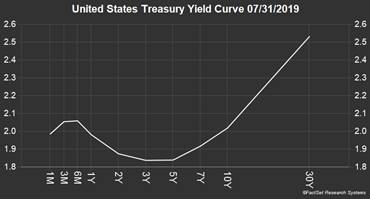
The current U.S. economic expansion has now passed the ten-year mark, and has set the record for the longest expansion on record. During that period, we have had three quarters of negative GDP growth, but in every case the economy bounced back the following quarter. The discussion has now moved to how to keep this expansion going. We can review the headwinds and tailwinds that currently coexist in the economy, but ultimately, we have to focus on the elephant in the room that underlies the Federal Reserve’s concern – the inverted yield curve.
First let’s look at what is working. The unemployment rate has been at 4% or below since last spring, and even with some signs of economic slowing, there is no indication that the rate will rise materially in the near future. Other labor market indicators that could indicate an overheating labor market would include weekly hours worked and capacity utilization and neither has moved up significantly in recent months. Some point to average hourly earnings growth moving above 3%, but this just moves wage growth back to the long-term average after a decade of subpar growth. New and existing home sales have remained strong, and growth in home prices has slowed somewhat, which may bode well for a continued strengthening of the housing market. Reasonable home price growth prevents prices from significantly outpacing income growth. The stock market has provided the big positive surprise this year, although you wouldn’t know it from reading the economic headlines. The S&P 500 is now up over 20% in the first seven months of the year. The bond market has participated as well, with Treasuries, agencies, and corporates all showing strong total returns this year.
There are reasons to worry, and China and tariffs are one concern. The tariffs have not seemed to make a significant dent in overall economic growth, although they have led to disruption in some industries and caused significant supply chain modifications. Overall global growth has been voiced as a concern by the Fed, and they seem to be more concerned that slow overseas growth could be more of a drag on our economy than it has been in the past. Market valuations in the U.S. are a concern, as earnings growth has slowed and the price to earnings ratio of the S&P 500 has moved back up to near 18 times. It is also troubling that small cap stocks have not fully participated in the move to new market highs, as the Russell 2000 index is still down almost 8% from its high last summer.
It seems to us that the elephant in the room is the yield curve. A negatively sloped yield curve can be telling us many things about the economy and the markets. It can tell us there is an aversion to risk taking. It can be telling us that there are too few investment opportunities that can be perceived as fairly priced. It can be telling us that market participants are concerned that economic conditions will weaken soon. The Fed can address a flat or negative yield curve by cutting rates, and time is of the essence. The irony for the Fed is that if they move more aggressively to lower rates, they may not have to cut as much as they will if they drag their feet. The three-month Treasury bill has had a yield above the ten-year Treasury for about nine weeks. If the economy is a car, the analogy would be a low fuel light that comes on. Can you keep driving for a while? Sure, but the risk increases the further you go. Post yesterday’s Fed decision, yields on the short end of the curve rose and rates on the long end of the curve fell. The stock market fell. Chairman Powell, it is long past time to listen to the markets.
Random Thought for July 2019: “Internet can destroy our party and our country” – Xi Jinping, President of the People’s Republic of China
Behind the Curve
June 27, 2019
Dow: 26,527
This phrase is used to describe a Federal Reserve and Federal Open Market Committee that is out of sync with the markets. They are always using many measures of rates, economic activity, employment, and inflation in an attempt to set an interest rate that neither encourages irresponsible risk-taking nor hinders growth. As part of our investment management process, we do the same thing in an attempt to better gauge where the economy and the markets are going, and use that information to position portfolios properly to benefit under the most likely outcome. In life, business, and sports, preparedness and anticipation usually lead to greater success. By being “behind the curve,” the Fed is being reactive, and since monetary policy operates with somewhat of a lag, this approach can compound errors and swings in the economy.
So what economic indicators should the Fed be heeding? There are a number of them that we would suggest and that we also use to try and gauge which way the economic winds are blowing. Oil and other commodity prices give a simple price signal. Oil spiked and then fell last year, but now is back to its longer term average of between $50 and $60 per barrel. A broader index of commodities has stayed near its fifteen year low for the last few years, signifying a troubling lack of inflation. The dollar has been strong versus other global currencies, and it would be weaker if market participants thought there was a danger of inflation. Wage growth has been moderate, and wage growth would certainly be higher if individuals thought there was any danger of higher future inflation. The Fed seems totally confused by the combination of low inflation and low unemployment. Housing price growth has also slowed nationwide to the low single digits, so no inflation concern there.
There has been much talk and consternation about the inverted yield curve. We believe an inverted curve, where long rates are lower than short rates, is a market indicator that the Fed should respect. The shape of the yield curve, and longer rates, comprise the sum total of the market’s collective knowledge about where rates are headed. It also gives information on whether market participants think the Fed is ahead or behind the curve. When the Fed increases short rates and long rates do not move up along with them, it is a sign that the Fed is too tight and is hindering potential economic growth. Low inflation can actually discourage investment and risk taking, as businesses are discouraged from investing due to a feared lack of demand. Japan is the most extreme example, but low growth plagues most areas of the world right now. The market now expects three rate cuts this year, and one more in the first half of 2020. The Fed should listen to the market.
As we have said before, our investment approach in our different strategies must reflect the risks and realities in the market. In our equity strategies, we hold companies that have meaningful advantages in their business areas, with proven management. We also look to hold companies that can grow revenues, although these become rarer and more expensive in this environment. In our fixed income strategies, we also maintain a balance of credit exposure, duration, and yield. We try to diversify risks as much as possible in our bond holdings, but inevitably all bonds are slightly riskier as yields move lower. Our goal is to anticipate market conditions, and avoid being surprised by unseen events. Our goal is to remain ‘ahead of the curve’ in the markets.
Random Thought for June 2019: The only thing that is constant is change – Heraclitus
Inequality
May 31, 2019
Dow: 24,815
Inequality is certainly a subject that has been the focus of much discussion over the last decade. It is a topic in many political and economic discussions. What should we do about it? Can it be reduced, why does it always seem to be increasing? What level of inequality is tolerable, and how do we get there? Any of us that have raised children through their pre-teens has heard the cry, “It’s not fair!” To which the standard parental response is “It may not be equal, but it’s fair.”
Inequality may very well be a natural phenomenon. It is found in almost all aspects of life. One of the difficult goals of modern societies is reducing oppression and unfairness while still maintaining incentives for people to strive to improve their lot in life. In this country we have incentives to own homes and advance our education. We have concluded that encouraging these things both improves individuals and improves society. People generally will support broad efforts that they believe will improve society as a whole.
Marxism, socialism, and communism all claim to deliver a more prosperous and a more equal society, but almost always fail to deliver. Their economic policies stifle creativity and incentives, and typically result in suboptimal growth and innovation over time, so those societies become less wealthy and less efficient over time, and have an overall lower standard of living. They also fail to alleviate inequality, and actually tend to expand the gap between rich and poor. In most repressive societies, the leaders appropriate huge riches. After his death, it was discovered that Fidel Castro maintained a luxurious private island off the coast of Cuba. Vladimir Putin is believed to be one of the richest persons in the world.
Karl Marx talked about units of capital and units of labor. Units of capital are equal. A dollar is a dollar. Marx failed to see that units of labor are not equal, and vary widely in value. Those individuals with extremely specialized skills that are highly valued by the market and others are paid very well. Even among small groups of individuals with rare skillsets there is great inequality. Giannis Antetokounmpo, the highest paid player on the Milwaukee Bucks, makes almost twenty times more than Sterling Brown, the thirteenth highest paid player on the team.
In our economic world, specialization has become a key characteristic of societies that are able to grow cumulative wealth. Specialization, which naturally goes hand in hand with inequality, has helped individuals, companies, and societies grow cumulative wealth in a more complex world. At Dana, a firm with 44 people, virtually all of us have specialized skills that do not overlap directly with the skills of others at the firm. This level of specialization greatly expands our cumulative depth of knowledge as a firm. We are different, we are diverse, and ideally this diversity increases over time as we all strive for excellence in our own area of expertise.
Certainly not all companies are equal, and like individuals, each is striving to gain a competitive advantage. We do depend on rules and laws to keep the playing field level, but we should always try to avoid regulation that limits innovation. The core goal of investment management is identifying companies that can successfully expand and grow, or become ‘less equal.’ If you look at a distribution curve for the market based on company market values, it would be skewed to some very large companies at the top, just like a distribution curve of individual wealth in the U.S. Programs that allow an individual to become more valuable, and increase the value of their labor through education or training, almost always are good investments. In order to reduce inequality, maybe our goal as a country should be to enhance the specialized skill set of each individual, and make each person more special rather than more equal.
Random Thought for May 2019: “Everyone is free to write and say whatever he likes, without any restrictions… [but the party] would inevitably break up, first ideologically and then physically, if it did not cleanse itself of people advocating anti-party views.” -Vladimir Lenin
We Are Not Japan
March 27, 2019
Dow: 25,625
Are we? Japan has been the opposite of an economic success story for the last 25 years. Japan’s debt to GDP level is 235%, its GDP growth rate has averaged below 1% for the last 20 years, and its inflation rate has been flat to negative for significant periods. The U.S. has struggled to produce a strong recovery from the last few economic downturns, even though fiscal and monetary stimulus has provided what should have been a significant tailwind. European GDP and debt cycles have begun to look more like Japan recently, and the United States is struggling with similar debt and growth issues.
If we look back on the recent experience of Japan and Europe, we can begin to see a relationship between overall government debt levels, inflation, and growth. Over the last few decades, the correlation has not been what was expected. The U.S. has a current debt-to-GDP level of about 100%, inflation below 2%, and an economic growth rate below 3% in 2018. In the recent past, the current level of economic and monetary stimulus would have produced significantly higher levels of inflation and GDP growth. Between 1980 and 2000, the U.S. regularly produced average GDP growth above 4%. Since 2000, we have had only two years with annual GDP growth above 3%.
Portugal has a debt-to-GDP level of 127%, but a 10-year government bond yield of only 1.27%. Japan has the highest debt-to-GDP level of the developed world, yet their 10-year government bond yield is actually negative. For countries with reasonably developed economies, as debt levels grow, it seems that inflation levels and potential GDP growth is suppressed. Countries get less “bang for their buck” in terms of economic growth for a given level of fiscal or monetary stimulus. Since the early 1980s, the U.S. debt-to-GDP level has grown, but real economic growth and inflation have trended downward. Maybe we are like Japan.
Modern Monetary Theory (MMT) has been in the news lately. It postulates that countries with their own currency don’t need to issue bonds but can simply print money to cover their deficits. This is a seductive proposition as it suggests governments can spend as much as they want without a problem, until there is a problem. Currency and debt are basically a confidence game. Now more than ever, the level of confidence can be fleeting. There has been little confidence in Greece’s ability to pay its debts without assistance from the European Union. Greek interest rates fluctuate directly in relation to the probability of the next bailout.
Most developed countries have begun to employ some version of stimulus that moves towards MMT over the last few cycles: more debt, more money printing, larger fiscal deficits. Each time it is done, the level of success decreases. Since most developed countries have not been disciplined through inflation for their profligate spending, purveyors of MMT think they have found a free lunch. There is a saying that entities go bankrupt slowly, and then all at once.
In the U.S. markets, we can react to the slower growth, lower inflation environment in our investment portfolios. In the fixed income markets, we manage our credit risk carefully and ensure that our duration is not too low. Among equities, larger, more established companies generally fare better than smaller companies as larger companies can fund themselves through debt offerings, and they typically have an easier time navigating the regulatory environment. Growth is rarer, highly sought after, and rewarded by market participants. We have seen this trend over the past two decades with the successful growing stronger and some industries taking on a winner-take-all environment.
Zimbabwe offers an extreme example of a government that printed money with abandon; the result was an inflation rate that surpassed 200,000,000% when the government stopped publishing the inflation figures in 2008. The largest denomination bill printed by the Reserve Bank of Zimbabwe was a $100 Trillion (100,000,000,000,000) in 2008; the currency ceased to exist as a unit of exchange in 2009. Now the South African rand, the British pound, and the U.S. dollar are all accepted currencies in Zimbabwe. Ironically, the image on the back of every piece of Zimbabwean currency was a pile of rocks. The U.S. is in better relative shape, but we should heed to observable lessons of other countries and plot our own better course.
Random Thought for March 2019: “Sound policy condemns the practice of accumulating debts” – Alexander Hamilton, New York Ratifying Convention, U.S. Constitution, 1788
We Have Reached Cruising Altitude
February 25, 2019
Dow: 26,092
We certainly had a bumpy ride there at the end of our interest rate climb. It is time for the Fed to level off, take their hands off the controls, and turn the seat belt sign off. Let market participants move about the cabin and assess the current economic and market situation without any further input from the Federal Open Market Committee.
It is difficult to look at the market events of the last five months without laying the mantle of responsibility on the Fed. As equity markets fell in October, November, and December, the Fed did virtually nothing to change their tone, and followed through with their fourth rate increase of the year on December 19th. It appears we now know what kind of a market swoon it takes to get the Fed’s attention. From its high on September 20th, the S&P 500 Index fell 14% through the Fed meeting date on December 19th. Jerome Powell’s news conference following the meeting outlined their intent to continue rate increases and the runoff of the balance sheet. In the next three days, the S&P 500 Index fell over six percent for a total decline of almost 20% from the September high. This move did get the Fed’s attention, and members of the Board of Governors and Fed presidents began commenting in far more conciliatory tones.
One of our concerns in January was that the market rebound would be so strong that the Fed would forget the message sent by the market in December. On the date of the January meeting, the S&P 500 Index was up 7% for the year and 14% from its Christmas Eve low. The interest rate doves got what they wanted from the January meeting, as the Fed did not raise rates and said, “The Committee will be patient as it determines what future adjustments to the target range for the federal funds rate may be appropriate to support these outcomes.” Patient is the keyword here, and the Fed backed up their change of heart by discussing an end to the shrinking of the balance sheet at the January meeting.
Although the Fed has said they will still be flexible with regard to incoming information, it is clear to us that the inertia is now indicating they will stay put. This is an entirely different mindset from the Fed compared to the last four years, when their bias was to raise if they could.
Now they need a reason or reasons that indicate significantly stronger inflation in order to raise rates again. We still worry about the fragility of the system. Debt levels are setting records at the sovereign level, and they have been increasing at the consumer level. There are warning signs indicated by the subprime auto loan market. To ensure that we are out of the woods, we would like to see commodity prices stabilize or even drift upward. We would also like to see the dollar remain within a range and not strengthen, and high yield spreads remain at reasonable levels and not gap up. We would even like to see longer Treasury bond yields drift upwards. So far this year, Treasury yields have not moved much from where they were at the end of the year. To us, that indicates that there still is some skepticism about this rally.
Earnings season was the weakest in two years, and expectations for 2019 earnings have been coming down. This does not have to be bad news for the equity market, as clearing a lowered hurdle can still result in market advances. Low and steady interest rates can also help support higher price-to-earnings ratios, and this could help drive the market higher. We are seeing market breadth broaden, which is creating more rewarding opportunities. Let’s hope we can maintain this cruising altitude in the market this year, and avoid any unexpected turbulence.
Random Thought for February 2019: “Games are won by players who focus on the playing field – not by those whose eyes are glued to the scoreboard.” – Warren Buffett